
The first astronaut crew to wear a mission patch was the Gemini 5 crew of Leroy Gordon Cooper and Charles “Pete” Conrad. No crew prior to Gemini 5 wore a mission patch on their flight — only the NASA insignia and a name tag.
 But the two previous Gemini crews did have medallions made, and carried some
on their flights. In the case of Gemini 3, the artwork for this medallion
depicted a Gemini capsule serenely floating in the ocean, awaiting recovery —
in contrast to Grissom’s previous flight where, after splashing down, a
prematurely jettisoned hatch caused his “Liberty Bell 7” Mercury
capsule to sink to the bottom of the Atlantic. The Gemini 3 radio callsign,
Molly Brown, emphasized that like the Broadway star, she would not
sink. According to John Young, during his Apollo training Gus Grissom had a batch
of patches made based on the art created for the medallion.
But the two previous Gemini crews did have medallions made, and carried some
on their flights. In the case of Gemini 3, the artwork for this medallion
depicted a Gemini capsule serenely floating in the ocean, awaiting recovery —
in contrast to Grissom’s previous flight where, after splashing down, a
prematurely jettisoned hatch caused his “Liberty Bell 7” Mercury
capsule to sink to the bottom of the Atlantic. The Gemini 3 radio callsign,
Molly Brown, emphasized that like the Broadway star, she would not
sink. According to John Young, during his Apollo training Gus Grissom had a batch
of patches made based on the art created for the medallion.
While I have never seen a photo of Grissom himself wearing one of these “Molly Brown” patches, there are numerous photos of Young wearing this patch: posing for Apollo 10 crew portraits, during his training for the Apollo 16 mission, and during the Shuttle era. So it is clear that both Grissom and Young adopted this as their Gemini 3 mission patch ex post facto.
The Gemini 4 crew of James McDivitt and Edward White also carried medallions, but neither of them ever made the medallion artwork into a patch. Presumably this is at least in part because McDivitt insisted that the American flag had been the “mission patch” for their flight. Decades later, desperate for a patch to fill the void, collectors took the medallion artwork (a bald eagle perched on a Gemini capsule) and had patches made from it. Since the crew never took the initiative to create one, and never wore such a patch, it can hardly be considered a “real” mission patch.

A flown Fliteline “Molly Brown” medallion.

This replica “Molly Brown” patch was made by John Berry in 2008.
On 22 January 1968, the first flight-worthy LM, designated LM-1, was launched into earth orbit aboard a Saturn IB as Apollo 5. There was no crew aboard, and this was the only LM to fly without one. The engineers at Grumman Aircraft, who had built the LM, felt that the mission deserved a patch, and so asked Grumman technical artist Richard Max Hinton to design one for the mission. One of the objectives of the flight was to test “fire in the hole” — ignition of the ascent stage engine while the LM’s two stages were still mated. This is the inspiration for the design on the patch. Since there was no need for — nor way to test — the landing gear, it was omitted on LM-1. The moon, the LM’s ultimate destination, appears on the right of the patch.

[ap05-aw1]
The original artwork for the LM-1/Apollo 5 patch as executed
by Grumman artist Richard Hinton. My thanks to Chris Spain for this image.

[ap05-em1]
This is the embroidered patch created by Grumman for the first
flight of the LM. My thanks to the late Lee Brandt for this image.
Building 32 at the Manned Spacecraft Center (now known as Johnson Space Center) contains two monstrous vacuum chambers that can, except for weightlessness, simulate the conditions of space. Chamber A has an internal working volume 27m high by 17m diameter, and the volume of chamber B is 8m high by 8m diameter. Chamber A has a rotatable floor and a 12m side access door; chamber B has a removable 10m top access hatch. Both chambers have airlocks for personnel access. Entire spacecraft can be emplaced in these chambers and subjected to less than one ten-millionth atmospheric pressure (equivalent to 200 km altitude), and temperature extremes of −193°C to +127°C. Entire missions were simulated inside these chambers.
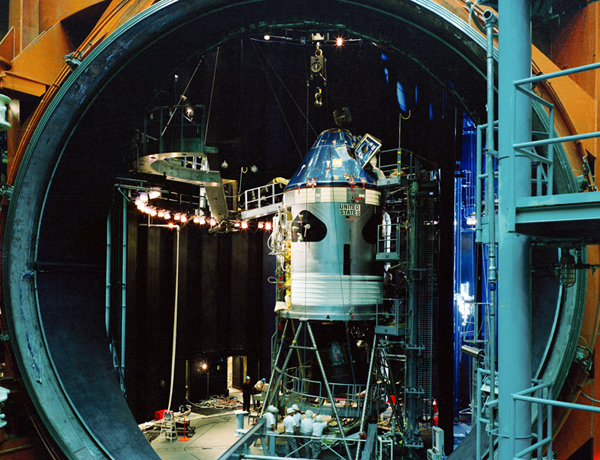
NASA photo S68-34803
This is a view of the 2TV-1 spacecraft inside chamber A,
looking through the doorway. Banks of powerful lamps inside the chamber
simulate solar irradiation; while the chamber walls can
be cooled by liquid nitrogen to −193°C, simulating the
radiation-absorbing void of space. A huddle of workers in
hard-hats at the bottom of the image lends a sense of scale.
In mid-1968, prior to the first manned Apollo mission, astronauts Joe Engle, Vance Brand, and Joe Kerwin spent a week (16-24 June) in a simulated mission using the Block II thermal vacuum test article 2TV-1 (identical, except for some flight-qualified equipment, to Apollo 7’s CSM-101) inside chamber A. The crew devised a patch for this exercise which was a take-off on the NASA “vector” emblem. The red “vector” was replaced by a roadrunner (a bird that doesn’t fly), and “2TV-1” replaced “NASA”.
Joe Kerwin coined the motto which appeared around the border of the patch: ‘Arrogans Avis Cauda Gravis’: The Proud Bird with the Heavy Tail. Only 40-50 copies of this rare patch were manufactured although Beta cloth versions were created as well.
—Still, Relics of the Space Race
According to Hengeveld, the motto was a paraphrase of the Continental Airlines slogan “The Proud Bird With the Golden Tail.”
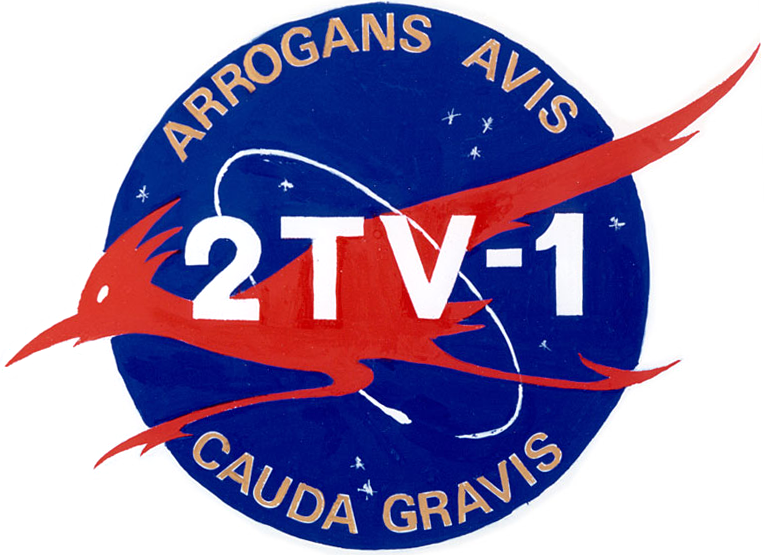
[2tv1-aw1]
NASA photo S68-27905
The original artwork for the 2TV-1 patch.

[2tv1-bc1]
Beta cloth version of the 2TV-1 patch. The circular
part has a diameter of 75mm, and the roadrunner is 116mm from beak to tail.
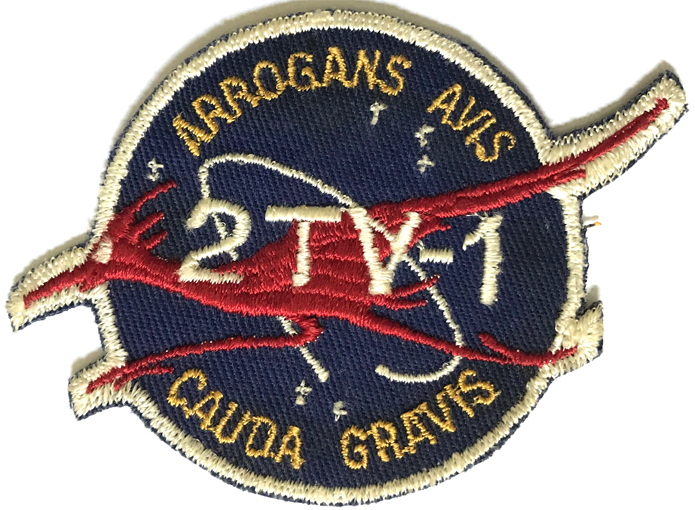
[2tv1-em1]
An original embroidered 2TV-1 patch. This patch belonged
to John Stott, who was a North American Aviation Flight Test Engineer at MSC
from 1965-1968. The circular part has a diameter of 75mm, and the longest
span from beak to tail is 116mm.

[2tv1-em4]
An outstanding reproduction by Chris Spain, this amazing patch
even has the same ripple effect on the body of the roadrunner as
the original.
The circular part has a diameter of 73mm, and the longest
span from beak to tail is 109mm.
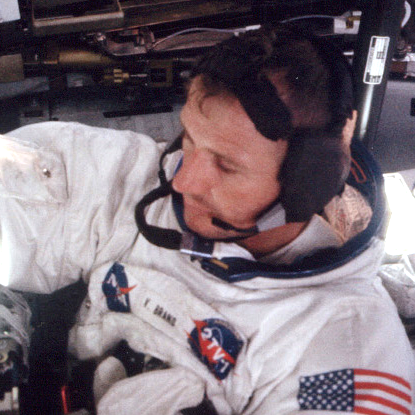
NASA Photo S68-39826
Vance Brand inside the spacecraft during the 2TV-1 test.
The 2TV-1 patch, the first crew patch to be printed on beta
cloth, is clearly visible. Thanks to Ed Hengeveld for this
image.
LTA-8 was the LM counterpart of the 2TV-1 CSM. LM Test Article 8 was put through a simulated flight in chamber B during roughly the same period 2TV-1 was being tested in chamber A. (In contrast to the 2TV-1 test, LTA-8 was not crewed during the entire course of the spacecraft test.) Astronauts Jim Irwin and John Bull were assigned to conduct this test; however, shortly before the test was to begin, Bull developed sinus problems exacerbated by pressure changes that required him to be replaced by his backup, Gerry Gibbons, who was a consulting pilot for the LM prime contractor, Grumman Aircraft.

[lta8-em3]
Chris Spain’s excellent replica.
82mm w × 124mm h

NASA photo S68-31953
This photo shows both Jim Irwin
(right) and Gerry Gibbons wearing the LTA-8 patch,
which is shorter than the two reproductions shown above.
No beta cloth version of this patch was made,
which meant that the embroidered versions which were used instead
needed to be removed during the test.
SMEAT (Skylab Medical Experiment Altitude Test) was a 56-day ground-based simulation which began on 26 July 1972. Intended to gather baseline medical data for the medical studies to be conducted during the Skylab flights, the crew of Robert Crippen, William Thornton, and Karol Bobko, ran through a full simulated mission including both a program of experimental studies, and housekeeping and leisure activities.
The crew worked with Peanuts creator Charles Schulz, who did the drawing for the patch. Snoopy, in his persona as a World War I flying ace, complete with flying cap and goggles, finds himself rudely tethered to the ground.

[smea-aw1]
NASA photo S72-44715
The original artwork for the SMEAT patch.

[smea-bc1]
Beta cloth version of the SMEAT patch.
78mm dia

[smea-em1]
An original embroidered SMEAT patch. Thanks to Bill Hunt for
this image.
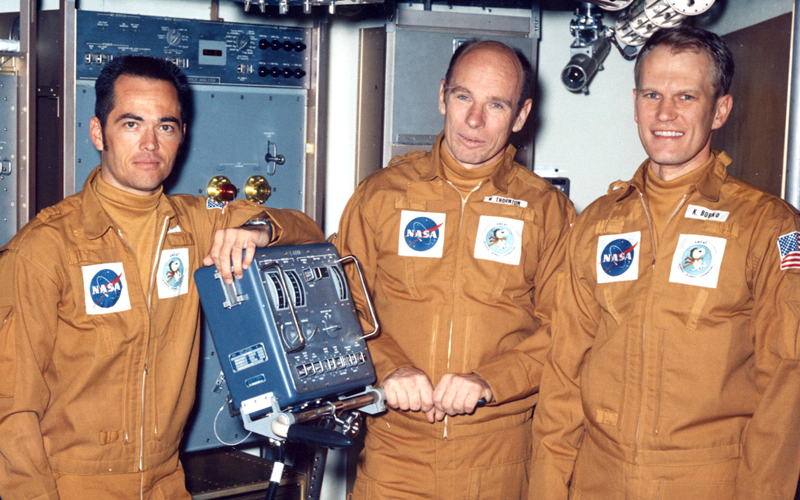
NASA photo S72-38270
The SMEAT crew of Robert Crippen, William Thornton, and
Karol Bobko.
As the [last Apollo] mission went forward, I felt increasingly frustrated and melancholy. I would often sit in the corner of the viewing room, silently watching the teams at work ... I also thought about the legacy of my generation: trust, values, teamwork. I wanted to be a living connection between the new generation of mission controllers, reminding them of how and where it all started with my generation and where theirs might take us in the future.
Bob McCall, in my belief the premier artist of space, had been sitting on the step to the right of the flight director console, sketching during the final Apollo EVAs. He had designed the Apollo 17 crew patch. When Bob took a break for a cup of coffee, I joined him in the cafeteria ... I don’t think Bob was surprised when I asked him to design an emblem for the Mission Control team. I spoke emotionally, from my heart and gut, about the control teams and crews, and our life in Mission Control. ‘We fought and won the race in space and listened to the cries of the Apollo 1 crew. With great resolve and personal anger, we picked up the pieces, pounded them together, and went on the attack again. We were the ones in the trenches of space and with only the tools of leadership, trust, and teamwork, we contained the risks and made the conquest of space possible.’
Over the next six months, McCall developed the emblem worn proudly by every subsequent generation of mission controller. He inscribed his final rendering of the emblem: ‘To Mission Control, with great respect and admiration, Bob McCall 1973.’
—Gene Kranz, Failure Is Not an Option
Apparently Kranz is being modest here, because McCall, in his Oral History interview, recalls: “[Kranz] was very, very instrumental in [the patch]. He was the one that asked me to do it, but also the one who really did most of the design. I just brought it together and in a way that could be reproduced nicely.”
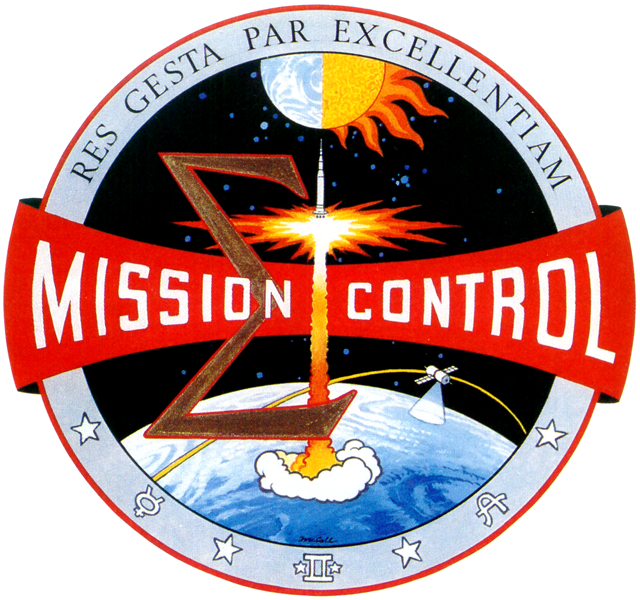
The Latin legend across the top, Res Gesta Par Excellentiam, translates as Achievement Through Excellence. The symbols on the bottom border represent the Mercury, Gemini and Apollo projects. This patch has been re-imagined over the decades, including symbols for Skylab, then Shuttle, and then the International Space Station. The Saturn V was first replaced by a Shuttle, and later with an abstract ascending vector. The Earth and sun have been replaced by the Moon and Mars. The legend “Mission Control” was replaced by “Mission Operations” and then “Flight Operations.” It will surely continue to elvolve.
[mico-aw1]
The artwork by Robert McCall for the Mission Control patch
comissioned by Eugene Kranz.

[mico-em1]
Embroidered reproduction of the Mission Control patch.
104mm w × 98mm h