
Virgil “Gus” Grissom
Edward White
Roger Chaffee
Allen Stevens

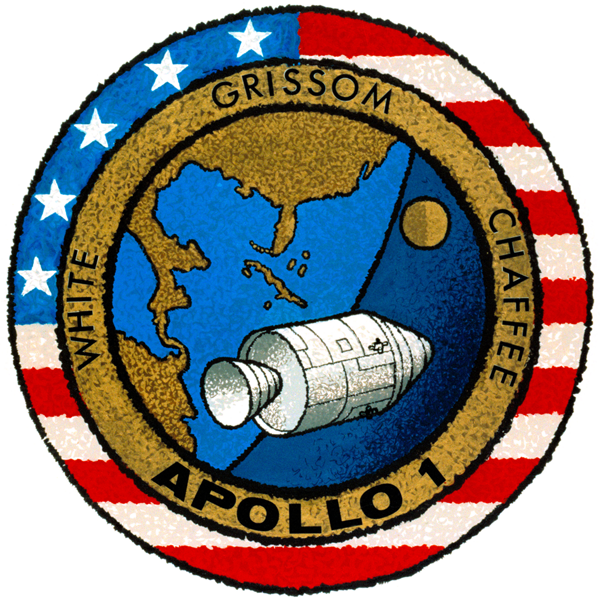
The crew thought of this mission as “Apollo 1,” and that is designation on the patch. While the patch design was approved in June 1966, by January 1967 there was some doubt what the flight would actually be called — officially it was being called Apollo 204 (2xx indicating the Saturn IB launch vehicle, and x04 indicating the fourth launch on that vehicle). So on 20 January 1967 George Low sent a letter to Deke Slayton withdrawing approval for the patch, and indicating that once the mission designation was firmly settled the patch might need to be revised. But the crew continued to wear the patch as designed.
Using the American flag as a border for the patch was an interesting design element that is unique to this patch, and hearkens back to the American flag that McDivitt claimed was the patch for the Gemini 4 crew for himself and ... Ed White.
The creator of this patch was unknown until May 2008, when Ed Hengeveld and Noah Bradley identified Allen Stevens of North American Aviation (the prime contractor for the Apollo CSM spacecraft) as the artist. Stevens went on to design the patches for Apollo 7, 9 and 10. In all cases, the design centered around depictions of the spacecraft, and they are the only patches in the Apollo series to do so.
On 27 January 1967 the crew perished in a fire that erupted in the spacecraft during a test at Launch Complex 34.
There was no Beta cloth version of the Apollo 1 patch — Beta cloth patches were instituted in consequence of the fire that killed the Apollo 1 crew, and used for all subsequent flights utilizing the Apollo CSM.
[ap01-aw1]
NASA photo S66-36742
The artwork by Allen Stevens of CSM contractor North American Aviation.
[ap01-em2]
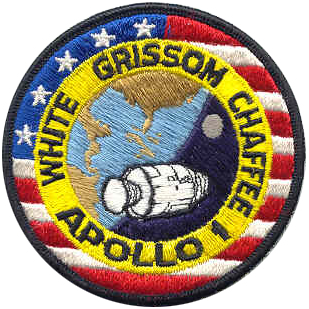
This is the patch worn by the crew. It was made by
Stylized Emblem Company of Hollywood, CA. While not particularly
faithful to the original artwork (the biggest deviation
is in the relative sizes of the border areas to the central
vignette), it certainly deserves to be called “authentic,”
since it is the design worn by the astronauts. Thanks to
Bill Hunt for this image.
[ap01-em3]
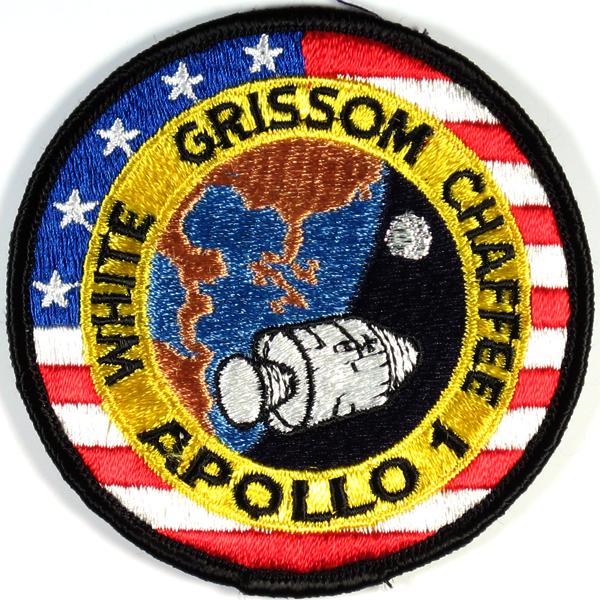
The most commonly seen embroidered Apollo 1 patch,
made by AB Emblem, is quite similar to the “authentic”
patch from Stylized Emblem. It can be easily distinguished from the
ap01-em2 by the stitching pattern in the image of the
Earth: on this patch the stitching is horizontal; on [ap01-em2]
this stitching is almost at right angles to the limb of the Earth.
Also, the moon in this version has silver threads. Finally, some of
the border stars in ap01-em2 are slightly distorted, while on
this reproduction they are more precisely rendered.
85mm dia
[ap01-em4]
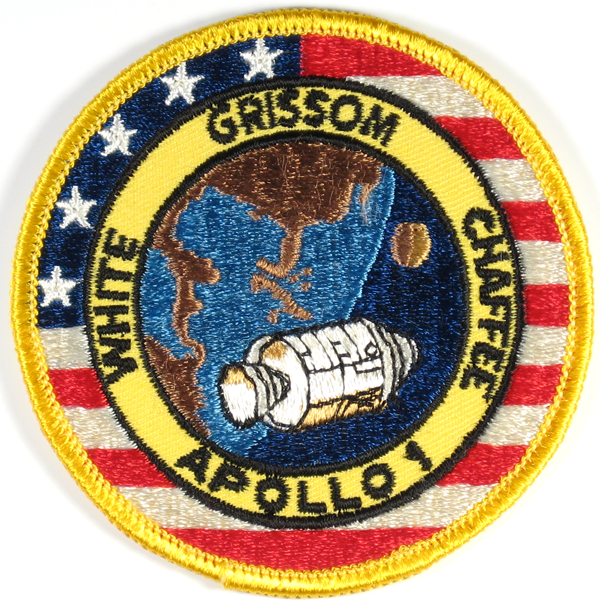
Unlike all other versions, this Lion Brothers patch has a yellow
border. Space is blue instead of black (making it the only embroidered version
to match the artwork in this respect); and the central vignette is too small
in relation to the overall patch. Otherwise, a nice rendition.
89mm w × 90mm h
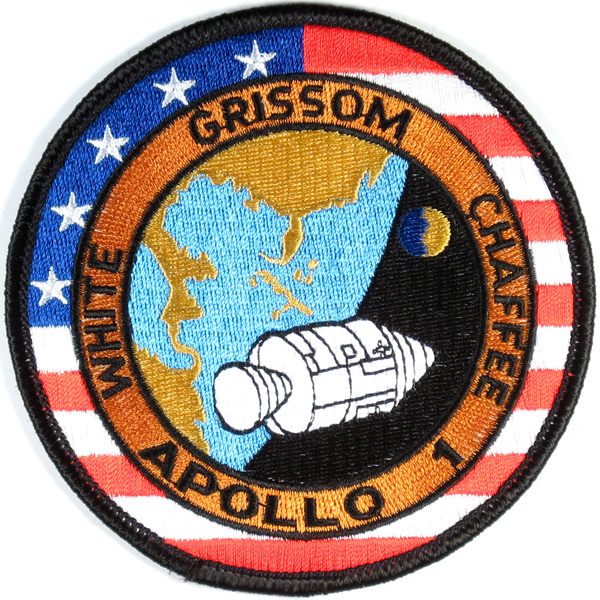
[ap01-em1]
This excellent embroidered Apollo 1 patch (a relatively recent version)
deviates only slightly from the artwork. The most significant
alteration is the omission of the black border around the
landmasses on the Earth — but then, none of the embroidered
patches include that. This excellent execution shows
just how attractive the Apollo 1 patch is.
101mm dia
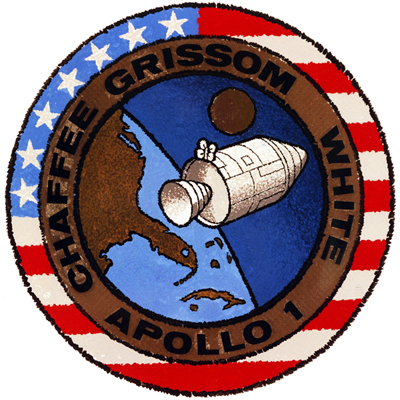
This is one of Allen Stevens proposals for the design. The crew
names in this version are in larger lettering, the same as “Apollo 1”;
plus “White” and “Chaffee” have swapped positions.
Also, there are 7 stars in the blue field of the border, suggesting that there
is no particular significance to the 5 stars in the final version.

NASA Photo KSC-366C-126-16
Roger Chaffee in
October 1966, wearing the crew patch on his left shoulder.

NASA Photo KSC-67PC-16.
Gus Grissom, ten days
before the fatal fire. Notice that the patch has moved to the right breast.

