

Bill Bradley developed two passions early in life — art and flying. He studied animation at the New York Cartoonists and Illustrators School (now the School of Visual Arts), which led to his founding a business back home in Houston, Animated Pictures. Bill worked on some of the earliest animations for NASA’s manned space program, providing material for films on Project Mercury. Animated Pictures ultimately merged with MSC’s prime film subcontractor, AV Corporation, and he became head of the animation department, and continued to produce films for Gemini, Apollo, and the Space Shuttle Program. In the early 1970s he left AV corporation to open a custom framing business, Bradley’s Art & Frame, which is still thriving after 52 years.
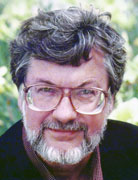
James Cooper was born in Opelika, Alabama in 1930, and studied at Auburn University. He then served in the Army Artillery Corps in Germany, which eventually led to an assignment at the ABMA in Hunstville. After the ABMA became the NASA Marshall Space Flight Center, Cooper transferred to the Manned Spacecraft Center in Houston, where he worked for 8 years. After leaving NASA he became a freelance artist. In addition to being a graphic artist, Cooper was also a musician, and played professionally at venues in the Houston area. Cooper died in 2016.
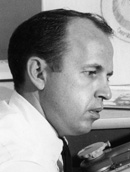
Victor Craft was born in Covington, KY in 1933, and studied at the University of Cincinnati where he earned a Bachelor of Science degree in Industrial Design in 1957. He and his wife Janet moved to Florida shortly afterward, where he worked for RCA Service Company, which operated the Missile Test Project from Patrick AFB. While his job revolved around technical art, he once remarked that he may have been a frustrated cartoonist at heart. Craft died in 2015.

Jerry Elmore was born in West Virginia in 1938. After relocating to the Houston area, he studied art at the Texas Academy of Art in the late 1950s. Through various contractors, he worked at NASA MSC for 25 years as a graphic artist. He did the final artwork for the Apollo 15, ASTP, STS-8 and STS-51C patches. Among his many awards and recognitions, he received the coveted “Silver Snoopy” award in 1969. Those of us of a certain age will instantly recognize the landing site artwork he did for the last three Apollo missions. When not at work, he was an avid fisherman. Elmore died in 2015.

Frank Kelly Freas was arguably the premier artist of science fiction and fantasy. Born in Hornell, New York in 1922, he spent much of his childhood in Canada. Folowing a stint in the Army during World War II, he attended the Art Institute of Pittsburgh, graduating in 1951. His career, spanning fifty-plus years, earned him ten Hugo awards, the highest recognition in the field. His art graced the covers of innumerable science fiction and fantasy magazines, twice winning readers’ poll awards for best cover of the year for Analog Magazine. In 2000 Freas was elected a Fellow of the International Association of Astronomical Artists. He died in 2005.

Richard Max Hinton was born in Stockbridge, Georgia, in 1941. He studied drafting and art at Florida’s Brevard Community College. In 1960 Hinton joined McDonnell Aircraft, working in the Technical Publication Department as a technical illustrator. He later joined Grumman Aircraft’s KSC operation as a commercial artist, tasked with special projects, including the of design of the LM-1 (Apollo 5) patch and a commemorative book of Grumman’s first eight years at the Kennedy Space Center. Following his stint at Grumman, Hinton worked in Lockheed’s Technical Publication Department as an Assistant Supervisor. He currently lives on the Space Coast, and enjoys traveling, drawing, and creating art for friends, family, and for his own personal pleasure.
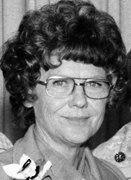
Barbara Matelski was born in Clayton, Georgia in 1923. Her mother was a concert pianist, and Barbara travelled with her on her concert tours, eventually visiting 44 states. She eventually ended up in Houston, and was the first woman to work as a graphic artist at MSC. She worked at NASA until her retirement. Matelski died in Tennessee in 2010.

Robert McCall was born in 1919 in Columbus, Ohio, and studied at the Columbus College of Art and Design. Science writer Isaac Asimov called him “the nearest thing to an artist-in-residence from outer space.” McCall’s giant mural in the National Air & Space Museum has become a cultural icon. If there was any doubt of his influence, his immortality was ensured when Stanley Kubrick commissioned McCall to produce a set of promotional paintings for the movie 2001: A Space Odyssey. In addition to the Apollo 17 and Mission Control patches, McCall designed five Shuttle mission patches. He also designed over a dozen US Postage stamps. McCall died in 2010.

Jean Pinataro began work at North American Aviation in 1949, creating technical art for flight handbooks which provided detailed information and procedures for test pilots who flew NAA aircraft, including the X-15 and XB-70. In 1967 Pinataro transferred to the Space Division in Downey, where she created artwork for the Apollo and Space Shuttle programs. In more recent years, Pinataro’s art has been influenced by her social conscience, which resulted in works such as her commentary on the Charles Keating S&L scandal, which appeared on billboards in the Los Angeles area. She died in 2019.
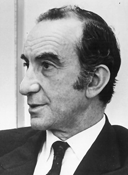
Emilio Pucci, Marchese of Barsento, was born in 1914 into an illustrious Florentine family. He was educated for a diplomatic career, and earned a Ph.D. in social science. A brilliant athelete, he was a member of the 1934 Italian Olympic ski team. He served as a career pilot in the Italian Air Force for 14 years, earning multiple decorations. While skiing in the winter of 1947, he met a fashion photographer who, when she learned that he had designed his own ski outfit, asked him to design some women’s skiwear. Thus began a long career as a fashion designer. In the 1970s Pucci was elected to the Italian Parliament. Later he began labeling and selling the wine produced on his estate in Chianti, owned by the Pucci family since the 13th century. He died in 1992.

Allen Stevens was born in Colorado Springs in 1915, and grew up in California. He studied at Art Center (now Art Center College of Design) in Los Angeles. While serving in the Navy during World War II, Stevens was aboard the escort carrier USS Guadalcanal (CVE-60) when she captured the German submarine U-505. Stevens worked first at Lockheed, and then at North American Aviation (later North American Rockwell) as a graphic artist. A modest man, he told a reporter who was writing a story about his patch work, “Don’t flower it up too much. It’s part of my job, that’s all.” Yet Steven’s patch designs were adopted by 4 crews, more than any other artist of that period. He retired in 1978, and died in 1994 in Orange, California.
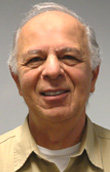
Born in 1940 to first-generation Greek parents, Anthony Tharenos began his career at McDonnell Aircraft in 1962, coordinating the artwork for the Gemini spacecraft specifications and configurations documents. Additional duties at McDonnell extended to more creative work as well. Observing that other artists in the McDonnell organization had designed patches for Gemini missions, he requested an opportunity to design one, and was assigned the Gemini 12 mission. Once the Gemini program ended, Tharenos held a number of art-related jobs in the St. Louis area until 1984, when he founded his own company, Tharenos Graphics. Tharenos taught in the Graphic Communications department of St. Louis Community College for 24 years. He is married to his high school sweetheart, and has two daughters, both of whom are MDs.

Norman Tiller worked on every US manned space program from Gemini to the ISS, and in nearly every medium including air-brush, oil, acrylic, watercolor, charcoal and pen & ink. Born in 1944, he spent most of his life in the Houston area. His wonderfully varied career began at Port Houston Shipyard where he was trained as a draftsman. His association with the space program began with a job at Lockheed, where he worked on the Gemini Program. A stint at Cape Canaveral with the Bendix Launch Support Division led him to grow into graphic illustration. Returning to Houston, was engaged by a series of contractors for NASA’s Technical Publications Department. His technical graphics work eventually led to engineering mockup and model work for Space Industries; and this in turn took him to Boeing, where he became a manufacturing engineer, building and testing Space Station hardware. In his retirement, he has engaged in painting murals for both commercial and residential clients.
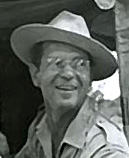
Born in Chicago in 1906, Walter Weber grew up as one of eleven children of poor immigrant parents. Showing an early talent, his pursuit of art was encouraged by his grade school and high school teachers. Weber studied zoology and botany at the University of Chicago, and upon graduation went on to study at the Church School of Art, the American Academy of Art, and the Chicago Art Institute. At just 22 years old, he got a job at the Chicago Field Museum, which gave him the opportunity to embark on extensive research travel. In 1936 Weber became the chief scientific illustrator for the National Park Service. In 1949 he was appointed staff artist and naturalist for the National Geographic Society, a position which allowed him to travel much of the world. In addition to illustrating many articles and books, Weber designed two Federal Duck Stamps (formally known as Migratory Bird Hunting and Conservation Stamps). He retired in 1971, and died in 1979.

Born in 1908, Lumen Winter spent his childhood in western Kansas. After attending the Cleveland School of Art and New York’s National Academy of Design, Winter participated in the Federal Arts Project set up by the Works Progress Administration, painting murals in public schools and post offices. During World War II he served a stint as an Air Force artist. Following this, he settled in Santa Fe. Over the next 40 years, Winter became one of America’s most reknowned muralists. His style, according to The Paris Moderne, “is not abstract nor is it realistic, but he has created synthesis which is all his own.” Winter died in 1982. In recent years there has been a resurgance of interest in Winter’s art.